From laser-cut acrylic to acetate
How an early idea for flat acrylic cat glasses became a more serious materials decision about shape, finish, manufacturing and what makes eyewear feel properly made.
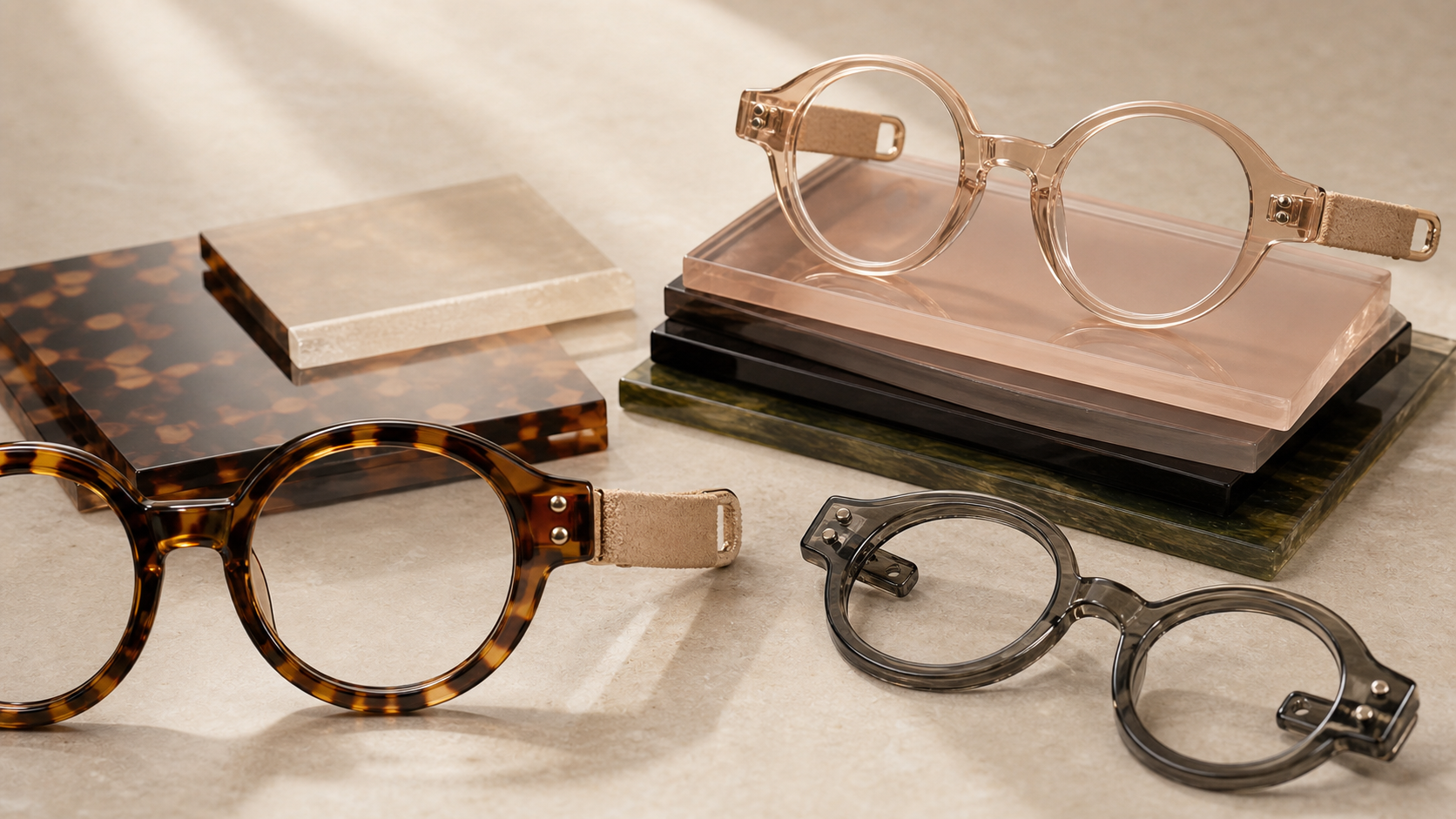
The first practical version of Catelier was going to be much simpler than the version I am working towards now.
I had bought a pair of cat glasses online. They were cute, and one of my cats could wear them briefly, but the object itself felt cheap: light plastic, fixed sizing, no real adjustment and very little of the detail that makes proper eyewear feel considered. On another cat they were too tight, which made the problem obvious. The idea was good. The fit and material were not.
My first thought was straightforward: make a better version myself.
The appeal of laser-cut acrylic
Acrylic made sense at the beginning. It is available in strong colours, it cuts cleanly on the right laser, and it can be bought in small sheets without committing to large manufacturing runs. For a one-person project, that was attractive. I could imagine drawing a frame, cutting a front, cutting two short arms, adding rounded strap slots, smoothing the edges and testing the proportions quickly.
There was also the equipment temptation. I started looking at compact CO2 laser cutters, sheet sizes, extraction, material suppliers and how many tiny frame fronts could fit on one bed. A small workshop route has a certain appeal: design the file, cut the part, learn immediately.
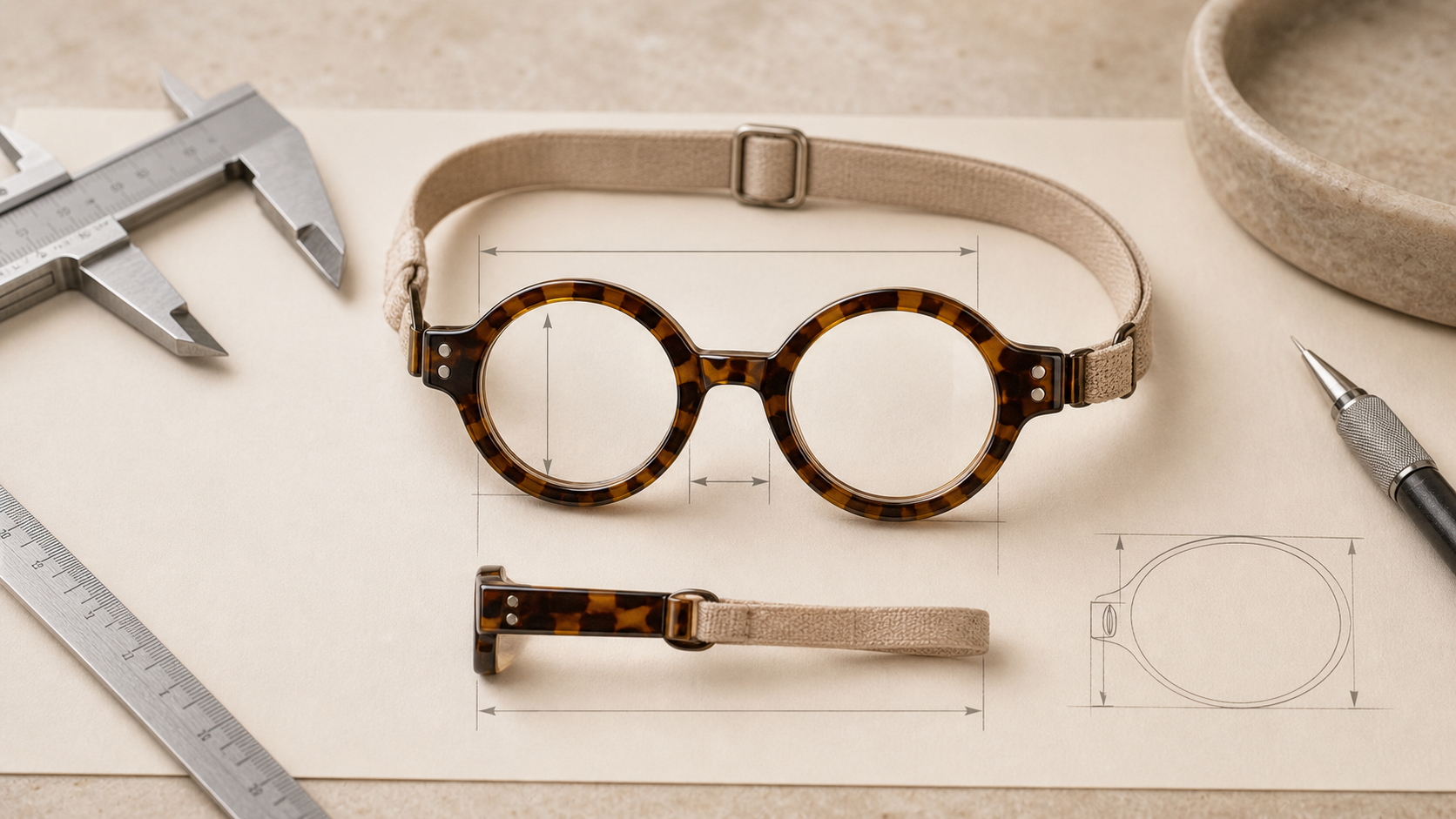
For Catelier, that route still has value for early fit checks. A card model or flat acrylic prototype can answer useful questions about width, eye spacing, whisker clearance, strap position and how the short side arms should meet the frame.
But it did not take long to see the limit.
Real glasses are not just flat shapes
Once I started looking more carefully at normal glasses, the flat-sheet idea began to feel too thin, in both senses.
Most eyewear is not simply a flat outline cut from plastic. The bridge is shaped. The frame has softness and rounding. Some designs have nose pads or nose-rest shapes built into the front. The brow can be thicker than the lower rim. The area around the hinge is often more substantial. The lens openings have bevels and grooves. Edges are polished rather than merely cut.
Those details are part of why a pair of glasses feels like eyewear instead of a costume prop.
At miniature scale, the same issue becomes sharper. If the frame is completely flat, it risks looking like a craft cut-out. If the edge is too square, it reads as unfinished. If the strap connector is just a tab, the side profile starts to lose the language of glasses. Catelier needs visible short arms, but those arms have to feel designed, not improvised.
That was the point where the material decision became a design decision.
The material problem
Laser cutting also makes the material question stricter than it first appears.
Cast acrylic can be a good laser material when the machine, extraction and safety setup are appropriate. It can give clean edges, useful colours and enough precision for early prototypes. But it still needs proper ventilation, test cuts, fire safety and a controlled workspace.
Other plastics are a different matter. Some materials used around eyewear or general plastic products are not suitable for casual laser cutting, and unknown plastics are a hard no. PVC, vinyl, ABS, polycarbonate and mystery sheets can produce harmful fumes or damage equipment. Tortoiseshell-style plastic is especially easy to misunderstand: something that looks like eyewear material is not automatically laser-safe acrylic.
That made me more cautious. If Catelier was going to be an eyewear object rather than a novelty accessory, I needed to think less like someone buying a sheet material and more like someone specifying a proper frame.
Why acetate changed the direction
The material I kept coming back to was acetate.
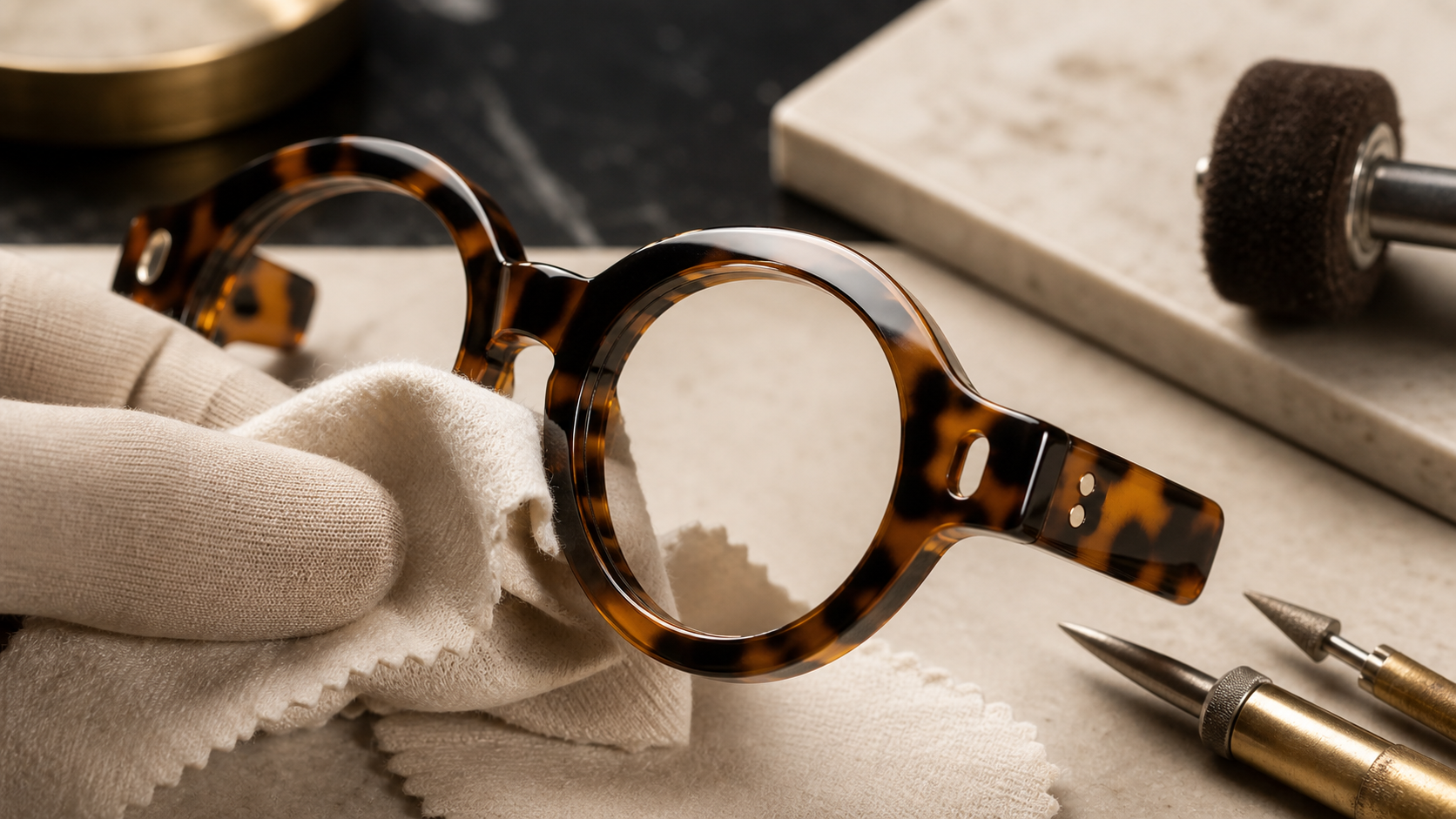
Acetate is common in higher-end eyewear because it gives depth, colour, polish and a more substantial hand feel than ordinary moulded plastic. It can be cut from sheet or laminated blocks, machined into shape, softened at the edges, tumbled, polished and finished in a way that feels much closer to a real optical frame.
That matters for Catelier because the product is small. The frame does not need to be heavy or overbuilt, but it does need surface quality. A polished acetate-style front with shaped thickness around the brow, bridge and lens openings is a very different object from a flat acrylic outline.
The trade-off is that acetate pushes the project away from simple home fabrication. It is not a material I want to treat as a casual laser-cutting experiment. The more appropriate route is closer to eyewear production: CAD, CNC machining, finishing, polishing, short arms, strap connector details and manufacturer feedback.
That is slower than cutting a flat sheet, but it is closer to the standard I want Catelier to meet.
Prototypes still matter
Moving towards acetate does not mean skipping prototypes. It means using prototypes for the right questions.
I can still model the frame in Fusion 360 or OpenSCAD. I can still use 3D printing to check scale, lens opening shape, bridge clearance and arm placement. I have an FDM printer at home, which is useful for rough iteration. Resin printing would give a cleaner small model, though for one-off parts the lead times and minimums can make it less immediate.
The important lesson was that a prototype should not be a shortcut around design. If the final product needs shaped thickness, softened edges and a proper side-arm construction, the model needs to express those decisions early. A flat pair of printed or laser-cut glasses can confirm some dimensions, but it cannot prove that the finished object will feel like eyewear.
So the CAD work has to become more realistic: thicker brow, thinner lower rim, shaped bridge, softened lens openings, separate short arms and rounded strap slots with enough material around them.
Why I started speaking to eyewear manufacturers
At that point I decided to contact manufacturers rather than solve everything through equipment buying.
I used AI tools to help with research and shortlisting, then looked for factories that already work with proper eyewear materials, sample-making, acetate, hinges, finishing and packaging. China became an obvious place to investigate because of the eyewear manufacturing base and the wider supplier ecosystem around frames, straps, cases and presentation packaging.
The first outreach was deliberately positioned as miniature premium eyewear, not toy pet glasses. That distinction matters. I am not looking for a novelty supplier to make a cheaper version of what already exists. I am looking for manufacturing advice on how to make the object feel closer to designer optical frames, while adapting the construction for brief, supervised cat wear.
The key questions now are practical ones: which material is realistic at a small first run, how the short arms should be made, whether the strap connector can be integrated cleanly, what finish level is possible, and how to keep the frame light, smooth and whisker-and-ear friendly.
The decision underneath the decision
This material choice is really about what Catelier is allowed to become.
Laser-cut acrylic would have been faster and more controllable at home. It may still be useful for early tests. But acetate-style manufacturing gives the project a better chance of feeling like a miniature eyewear house rather than a dressed-up craft object.
That is the direction I want to explore: fewer shortcuts, better surfaces, better proportions and a product that earns its detail quietly.
The next part of the work is less romantic: drawings, samples, supplier conversations, tolerances, minimum order quantities and all the small manufacturing decisions that decide whether the idea survives contact with reality.